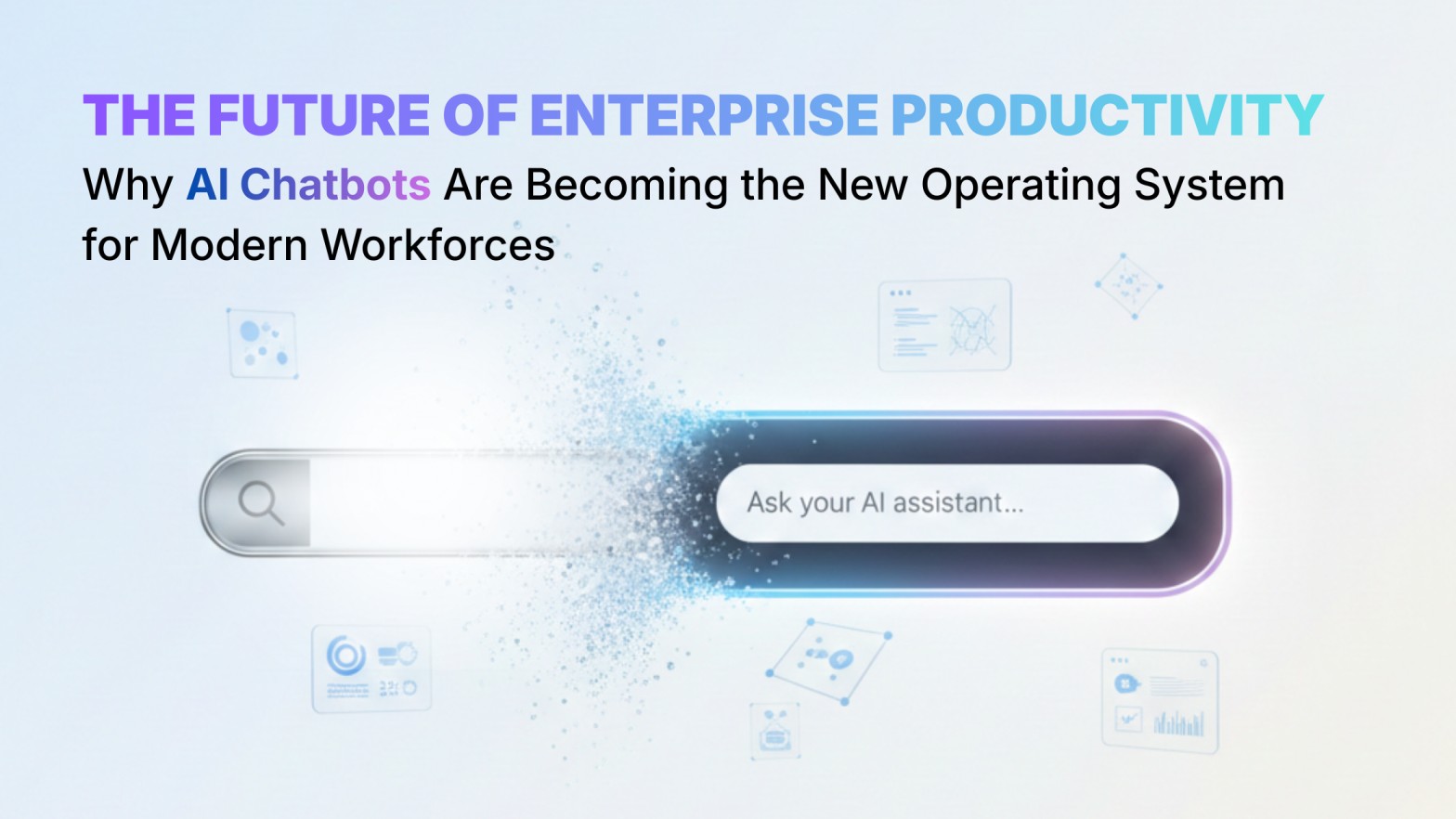



In every enterprise today, information exists everywhere — documents buried in shared drives, PDFs stored in siloed systems, knowledge locked inside wikis, emails, tickets, Confluence pages, and old archives.
This is where the next big leap in enterprise AI is happening — Retrieval-Augmented Generation (RAG). It’s quickly becoming the backbone of Enterprise Search AI, Document AI, and modern AI for Knowledge Management.
Retrieval-Augmented Generation (RAG) is an AI architecture that combines search + generation to deliver accurate, context-rich responses.
The result? A document-aware AI chatbot with precision, traceability, citations — and zero hallucinations.
Documents, PDFs, SOPs, manuals, slides, spreadsheets are broken into meaningful chunks.
Each chunk becomes a numerical embedding stored in a vector database.
User asks a question → retrieves relevant chunks → LLM reads them → generates grounded answers.
Traditional enterprise search is keyword-based. RAG changes that completely.
“RAG isn’t just another AI feature; it’s the bridge between enterprise knowledge and enterprise intelligence. In the upcoming years, RAG systems will become central to workflows across IT, HR, Operations, Support, and Compliance. Teams will no longer search — AI will simply answer. At Cloudstok, we see RAG evolving into an operational backbone — powering decision-making, reducing time-to-knowledge, and unlocking enterprise data value.”
— Prateek Rawat, Co-founder, Cloudstok Technologies
As enterprises grow, the gap between “information stored” and “information usable” widens. RAG closes that gap — bringing visibility, structure, and intelligence to unstructured data.
Cloudstok is actively exploring AI RAG, Enterprise Search AI, Vector Embedding pipelines, and Document AI for clients.
Want to stay updated? 👉 Follow Cloudstok for insights on RAG, Enterprise AI, and knowledge automation.