Logesys Case Study
About the Customer
Logesys Solutions India Pvt. Ltd. is a leading data and analytics management services provider headquartered in Bangalore, India, with sales offices across the Middle East and the United States. Founded in 2005, Logesys has been at the forefront of helping global enterprises turn complex data into actionable intelligence through its deep expertise in Advanced Analytics, Data Engineering, Automation, and Visualization.
For over two decades, Logesys has partnered with clients across retail, supply chain, manufacturing, life sciences, and chemicals industries—bridging the gap between raw data and strategic decision-making. Their core strength lies in combining techno-functional expertise with business context, enabling customers to make smarter, faster, and more confident decisions.
Over the years, Logesys has evolved from a traditional BI and analytics company into a next-generation AI and data innovation firm, driving transformation through cloud modernization, predictive analytics, and Generative AI (GenAI). Their flagship initiatives like Auto Reports and Auto Insights are redefining how enterprises visualize, automate, and interpret their data in real time.
Guided by strong values of Integrity, Commitment, and Competence, Logesys continues to innovate with a clear mission
— to deliver timely, relevant, and impactful solutions that transform how businesses operate and compete in a data- driven world.
Customer Challenge
As part of its ongoing digital modernization, Logesys sought to embed AI-driven intelligence into its internal and client- facing applications. The goal was to create an enterprise-grade AI foundation that could understand business data, automate repetitive tasks, and generate contextual insights using Generative AI (GenAI).
While Logesys had extensive structured and unstructured datasets — spanning CRM APIs, DAX definitions, and analytical models — it lacked a unified AI framework to interact with these data sources intelligently. The company needed an integrated, scalable, and secure solution capable of powering AI agents, knowledge bases, and prompt-driven automation.
Business Challenges:
- Disparate data sources and knowledge silos across CRM, API definitions, and analytics repositories.
- Manual and time-consuming data retrieval and insight generation processes.
- Absence of a centralized AI capability layer for analytics, support, and automation.
- Need for domain-aware, consistent, and explainable AI responses tailored to internal use cases.
Technical Challenges:
- Designing contextual AI agents capable of reasoning across diverse business datasets.
- Engineering optimized prompt templates for specific use cases like SQL generation, CRM queries, and API response interpretation.
- Securely embedding proprietary data into vector stores for Bedrock Knowledge Bases.
- Enabling concurrent, low-latency execution of multiple agents within a controlled architecture.
Risks and Impact if the Challenge Were Not Addressed
Without a unified AI framework, Logesys would continue facing inefficiencies and fragmented analytics. Potential impacts included:
Business Risks:
- Slower turnaround for business insights and operational decisions.
- Increased dependency on manual data retrieval and analysis.
- Reduced employee productivity due to repetitive analytical tasks.
- Loss of competitive advantage in delivering AI-enabled customer experiences.
- Missed opportunities for innovation and business automation.
Technical Risks:
- Data silos preventing effective use of analytics and AI pipelines.
- Inconsistent prompt and knowledge management leading to unreliable outputs.
- Lack of AI governance controls around access, traceability, and auditability.
- Security vulnerabilities in unencrypted or manually managed datasets.
- Difficulty scaling GenAI workloads or extending multi-agent workflows across environments.
Partner Solution
To address these challenges, CloudStok implemented a comprehensive Generative AI solution using Amazon Bedrock, establishing Logesys’ first enterprise-grade AI capability layer.
This solution leveraged Anthropic Claude Sonnet as the foundation model within Bedrock, supported by private knowledge bases and a multi-agent orchestration framework. It enabled Logesys to interact with its data
ecosystem through natural language prompts, automated reasoning, and intelligent task execution — all within a secure AWS environment.
Key highlights of the implementation:
- Foundation Model Integration
-
- Deployed Anthropic Claude Sonnet within Amazon Bedrock for advanced reasoning, summarization, and generation.
- Configured domain-specific prompt templates for SQL generation, analytics, CRM queries, and technical interpretation.
- Used prompt orchestration to ensure consistent, contextual, and business-aligned responses.
Knowledge Bases and Data Embeddings
-
- Created five dedicated Bedrock knowledge bases, each linked to proprietary Logesys data:
- Zoho CRM API Definitions
- DAX Query Reference Base
- Odoo API Response Documentation
- Auto Insights Repository
- Logesys Chatbot Conversational Corpus
- Configured automated synchronization with Amazon S3 data sources and applied AWS KMS encryption for security.
- Created five dedicated Bedrock knowledge bases, each linked to proprietary Logesys data:
- Multi-Agent Framework
-
- Implemented seven intelligent agents in Bedrock, each designed for specialized workflows:
- “Ask Feature” Agents for query interpretation and task automation
- “Auto Insights” Agents for analytics and report generation
- “Deep Dive” Agents for advanced reasoning and workflow orchestration
- “Streaming” Agents for real-time conversational interactions
- Configured supervisor logic for cross-agent collaboration and seamless workflow execution.
- Implemented seven intelligent agents in Bedrock, each designed for specialized workflows:
- Governance, Security, and Monitoring
-
- Implemented IAM roles and KMS policies for least-privilege access control.
- Integrated CloudWatch dashboards to monitor latency, cost optimization, and agent activity.
- Automated knowledge base updates via AWS Lambda triggers on S3 data refresh.
Functional Workflow:
- User Query Input
Users submit prompts through the Logesys internal interface — e.g., “Generate a DAX query for sales by region” or “Explain Odoo API response for customer creation.”
- Agent Selection and Routing
Amazon Bedrock intelligently selects the most relevant agent based on query type (e.g., analytics, CRM, or deep-dive reasoning).
- Knowledge Retrieval
The selected agent accesses contextually relevant information from the associated vector knowledge base stored in Amazon S3.
- Prompt Execution
Claude Sonnet processes the query using custom-engineered templates and contextual embeddings.
- Response Generation
The AI generates a structured, business-ready response (SQL code, insight summary, or explanation).
- Feedback Loop and Continuous Optimization
Responses are logged for evaluation and prompt improvement, enabling continuous model optimization and insight refinement.
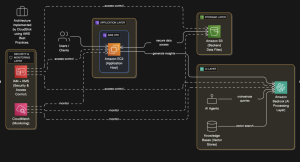
The Logesys AI architecture, implemented by CloudStok using AWS best practices, integrates application hosting, data storage, and Generative AI processing within a secure and scalable AWS environment. Users access the main application hosted on Amazon EC2 inside a VPC, which serves as the control centre for managing AI requests and data interactions.
All backend data files and analytics datasets are stored in Amazon S3, which provides secure, scalable, and highly available storage. The EC2-hosted application retrieves this data and interacts with Amazon Bedrock, where foundation models such as Anthropic Claude Sonnet process inputs, perform reasoning, and generate contextual insights.
Within the AI layer, AI Agents orchestrate queries and access multiple Knowledge Bases (vector stores) to enrich responses with domain-specific information. Security and access control are enforced through AWS IAM and KMS, ensuring data privacy and encryption across all layers. Amazon CloudWatch continuously monitors application health, AI performance, and system activity.
As an AWS Managed Services Partner (MSP), CloudStok Technologies delivered full lifecycle support, including edge deployment design, cloud architecture implementation, and generative AI integration. Post go-live, CloudStok continues to provide ongoing monitoring, incident response, model optimization, and support for continuous improvement. This end-to-end solution enabled Logesys to transform its quality assurance from manual, sample-based checks to AI-powered, real-time, and data-driven operations.
Quantified Business Outcomes
- 35% reduction in operational effort for report generation and data analysis.
- 50% faster turnaround in decision-making for key stakeholders.
- >90% accuracy in AI-driven data interpretation and DAX/SQL generation.
- Zero downtime during deployment and agent orchestration.
- 3× scalability gain, enabling expansion into new AI use cases.
Strategic Benefits
- Established a unified AI layer across internal and client platforms.
- Strengthened data governance through encryption and fine-grained IAM control.
- Enabled future GenAI extensions like Auto Insights and report automation.
- Enhanced competitive positioning as an AI-enabled analytics partner on AWS.